
Short answer: a local hot tub move typically costs $300–$800 with the right crew and equipment. Added to a long-distance household shipment, it usually adds a flat $300–$450 rather than pricing by mileage.
The $300–$800 local range mostly reflects how many hours the crew spends wrestling with stairs, gates, and tight corners rather than the distance driven. On a long-distance move, the truck and driver are already booked for your household shipment, so the hot tub is simply an oversize item occupying floor space inside the same trailer; that is why the add-on stays flat at $300–$450 instead of scaling with mileage. You will almost never see a per-mile rate for the spa alone because the carrier has already priced the fuel and drive time into the main household load.
What do you need to prep before the movers arrive?
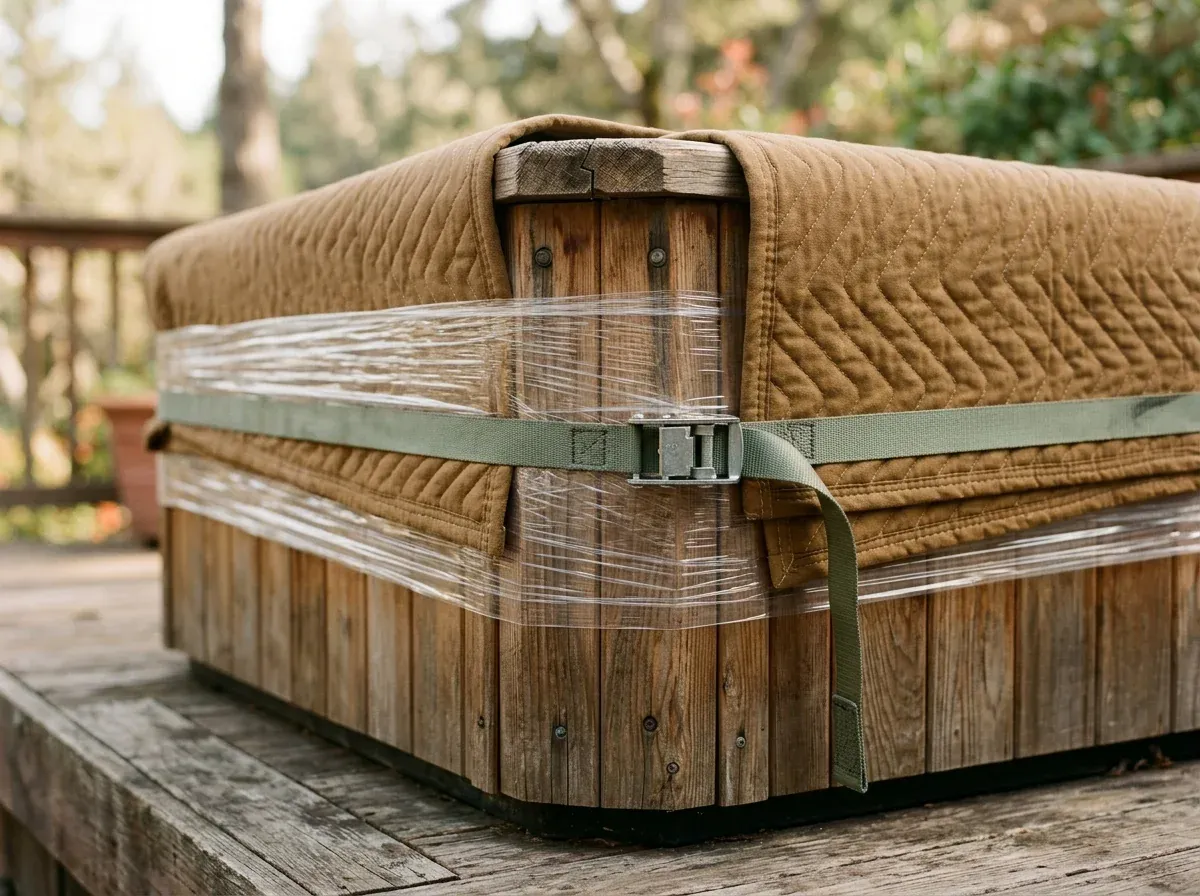
Draining the tub, disconnecting the electrical hookup (often a job for a licensed electrician if it's hardwired), disconnecting any plumbing, and removing the cover and skirt panels typically falls on you before movers arrive — none of that is part of the moving quote itself. What you're paying for is safely lifting, transporting, and placing the empty shell.
Movers generally refuse to touch electrical hookups because hardwired connections carry liability they are not licensed to assume. If your tub plugs into a standard outlet, you can simply coil the cord, but hardwired junction boxes require a licensed electrician to safely terminate the leads.
Any water hiding in the internal plumbing lines can slosh during transit, staining the truck bed or freezing into expansion cracks if temperatures drop overnight on the drive. Taking the time to blow out the lines with a wet-dry vac after draining removes that risk entirely and prevents mold from blooming in the dark hoses while the tub sits in storage.
The acrylic shell is surprisingly brittle when twisted, which is why the skirt panels and cover must come off before the crew arrives. Leaving them on creates leverage points that can crack the shell against a gatepost or stair rail during the pivot into the truck.
Once the shell is fully stripped and dry, place the hardware—screws, fasteners, and the removed access panels—into a labeled bin so they do not scatter during the load. The moving crew is responsible for the shell, not for remembering which bracket belongs to which corner of the skirt.
Homeowners sometimes assume the moving crew will reattach the skirt and electrical at the destination, but the reverse trip off the truck involves the same liability limits. You will need the same electrician to reconnect hardwired service and you should leave the panels off until the tub is positioned exactly where you want it.
Should you hire a regular moving crew or a hot tub specialist?
Many full-service moving crews can handle a standard rectangular or round hot tub with a proper dolly and enough hands, provided access (doorways, stairs, yard gates) is reasonable. Oddly shaped tubs, rooftop or elevated placements, or very tight access points are where it's worth asking specifically whether the crew has hot-tub experience or whether you need a dedicated specialty mover.
A standard full-service crew distributes the 400–900 lb load across carry straps and an appliance dolly, but the real challenge is not the weight itself. It is the bulky, flat-bottomed geometry that wants to slide off the dolly pad the moment the tub tilts for a stair or ramp.
Specialty crews bring hot-tub sleds—low-profile, padded skis that let the shell glide across grass or decking without catching—and inflatable air bags that can lift one side just enough to slide a dolly underneath in a tight side yard. Without those sleds, the crew must carry the full weight by hand across every soft patch of lawn, which burns through the clock and increases the chance of a drop. If your only access route is through a narrow gate or a finished basement walkout, that specialized equipment is often the difference between a clean move and a rescinded estimate.
Rooftop decks or elevated placements sometimes require a crane or boom truck, which is a separate subcontract from the household mover entirely. If your tub sits on an elevated balcony, ask whether the moving company will arrange that rigging crew or whether you must book the specialist yourself.
Even a standard crew should walk the path beforehand to check for overhead wires, sprinkler heads, or sinking pavers that could tip the dolly. A tub that is stable on flat concrete becomes a pendulum once it clears the edge of the patio and meets a slope.
How do you add a hot tub to a full-service moving quote?
If you're already comparing full-service moving quotes, flag the hot tub at the start — it's one of the checkboxes in the calculator above — so every quote you get already accounts for the extra crew and equipment instead of showing up as a surprise line item after booking.
When a hot tub is omitted from the initial inventory, the dispatcher does not reserve the extra hands or the padded dolly needed for a safe lift. On move day, the crew either refuses the item or stops the clock while someone rents equipment, turning a fixed bid into an hourly bleed. Either outcome strands you with a drained tub and a narrow closing window.
The extra cost baked into the upfront quote covers not only additional labor but also the trailer floor space where the tub sits. That section cannot be stacked with boxes, so the mover is essentially reserving unusable real estate inside the truck. That is why the $300–$450 add-on for long-distance moves is structured as a flat fee rather than pricing by mileage.
If the estimator visits in person, walk them down the exact path the tub will travel. Phone quotes rely on checklists that can skip the hot tub checkbox when the sales rep is focused on bedroom counts and furniture cubic footage.
Revealing the tub after the quote is locked forces the carrier to revise the rate on the spot to account for the unplanned crew and equipment. At that stage, your household is already packed and your alternatives are gone, so you are effectively forced to accept whatever surcharge the driver presents before the loadout continues.