
Short answer: local or regional motorcycle transport typically costs $150–$500. Cross-country, expect $400–$1,000+ depending on distance and whether you choose open or enclosed transport.
The $150–$500 local band covers short regional loops where carriers bundle several bikes in one day, while the $400–$1,000+ cross-country range widens because fuel, wages, and the open-or-enclosed choice all compound over long distances. Direct runs between major hubs on an open trailer land near the lower end, whereas remote pickups or enclosed delivery push the same distance toward the higher figures. Booking enclosed for a cross-country route through remote areas can push the final figure toward the top of the $400–$1,000+ span, especially if the bike is oversized or non-running.
Should you ship a motorcycle with household movers or a dedicated transport service?
If you're already booking a full-service household move, some crews will secure a motorcycle in the truck alongside your furniture using standard tie-downs — worth asking about specifically, since it's not automatically assumed. Longer distances, higher-value bikes, or moves where a full-service mover doesn't have the right equipment usually mean a separate, dedicated motorcycle transport service instead.
If the crew agrees, they usually wheel the bike in last so it sits near the door and can be tied off without crushing boxes against the fairing. Lay it on its side and you risk fluid leaks, scratched paint, and bent handlebars.
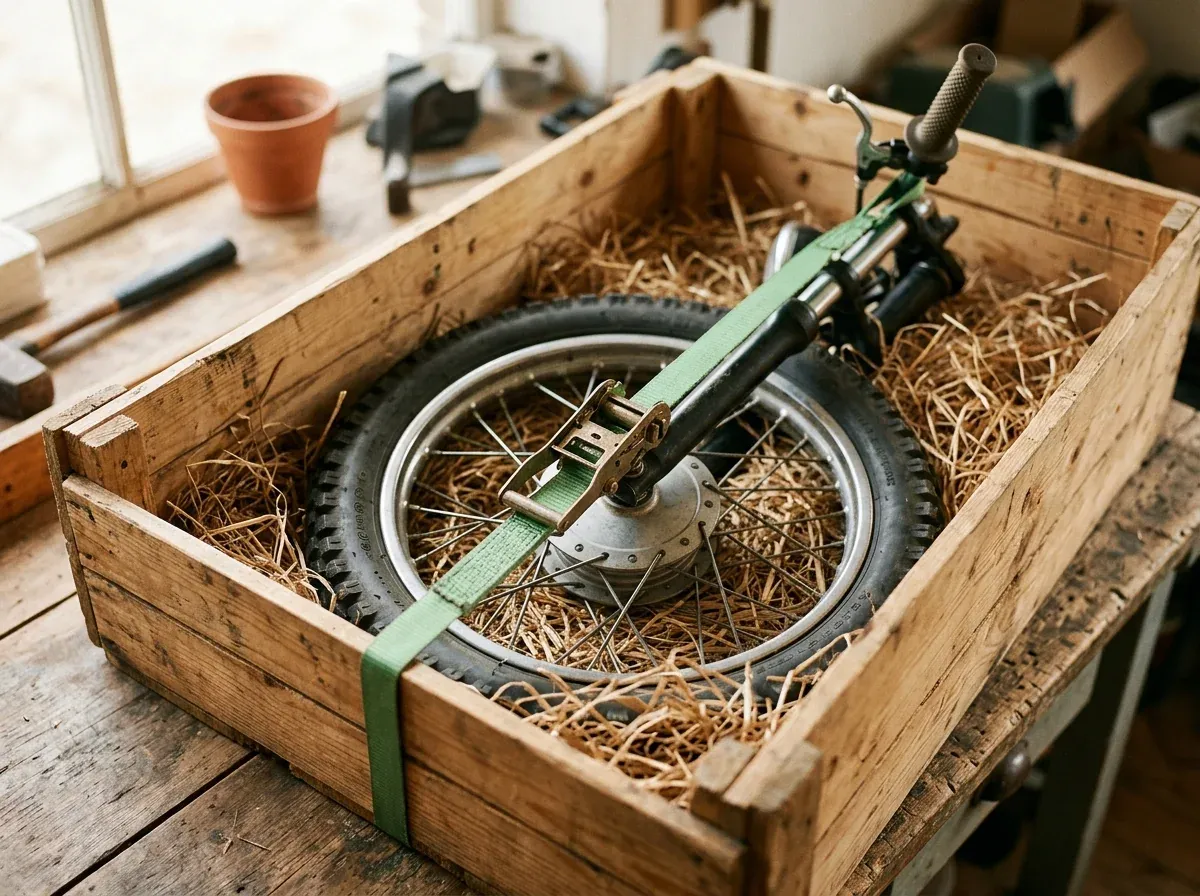
Dedicated carriers use chocks and soft-tie straps made for motorcycles, which prevents handlebar stress and keeps the suspension from compressing. A loose bike in a household truck can pivot around a single strap point and dent nearby furniture. That specialized gear is why vintage bike owners rarely trust a standard furniture dolly and moving blanket.
If the truck is near its weight limit or the ramp is too steep, the crew may refuse the bike on loading day. That forces a panic booking with a dedicated carrier at short-notice rates near the top of the $400–$1,000+ range. Flag the motorcycle during the quote phase so you can compare a real household add-on against a separate bid.
Open or enclosed transport: which should you choose?
- Open transport — the bike rides on an open trailer, exposed to weather and road debris. Cheaper, and the standard choice for most everyday motorcycles.
- Enclosed transport — fully covered, protected from weather and debris. Costs more but is the safer choice for a vintage, custom, or high-value bike.
An open trailer carries multiple bikes, so your motorcycle shares strap angles and suspension loads across several tie-down points. That works fine for factory paint, but custom paint or chrome collects road grit and tiny debris impacts over a long haul.
Inside an enclosed trailer, the driver controls moisture and temperature better, and the slipstream cannot peel decals or loosen mirrors. Enclosed carriers also attract drivers who specialize in vintage bikes, so they are more likely to own chocks sized for unusual tires and know how to strap a rigid-frame chopper without bending forks. You are paying for that expertise as much as for the walls around the trailer.
An enclosed trailer carries fewer bikes per run, so fuel and labor costs per motorcycle are higher. On an open hauler, the driver spreads diesel and wage costs across more loads, pushing the per-bike price toward the lower end. Choosing enclosed typically lands you in the upper half of whichever distance bracket applies.
What factors affect motorcycle shipping costs?
- Distance. The single biggest factor, same as household goods.
- Bike size. A full-size touring bike or trike costs more than a standard or sport bike.
- Running condition. A bike that can be ridden on and off the trailer under its own power is cheaper to transport than one that needs to be winched or lifted.
Longer hauls cost more in absolute dollars, but the per-mile rate drops when the carrier bundles your bike with others along a major interstate corridor. A rural pickup forces the driver off those corridors, adding deadhead miles that push you toward the upper end of the $400–$1,000+ range.
A touring bike or trike occupies more floor space and carries its weight higher, so the driver may need a wider chock or a reinforced ramp. If the carrier leaves a neighboring slot empty to accommodate that width, you effectively pay for two spaces, which pushes the price toward the top of the quoted range.
A non-running bike cannot be ridden up a ramp, so the crew must winch or lift it, then block the wheels because the transmission cannot hold it in gear. That extra handling means the company bills for labor and risk rather than just mileage. It also cannot be repositioned easily on the trailer, so the carrier loses routing flexibility that keeps multi-load trips efficient.
Because a non-running bike must stay where it is placed until the final destination, it often gets loaded last and unloaded first. That sequencing constraint removes some of the efficiency that keeps per-mile costs low on multi-load trips, so you end up paying for the convenience of a dedicated slot even if the truck carries other motorcycles.
How do you include motorcycle shipping in a full household move?
If you're comparing full-service moving quotes, flag the motorcycle at the start — it's one of the checkboxes in the calculator above — so every quote already accounts for it, or so you know upfront that you'll need a separate transport arrangement.
Moving calculators rely on cubic feet and weight, and a motorcycle consumes floor area plus tie-down points that would otherwise hold furniture. If you add the bike after the inventory is set, the crew may show up with a full truck or straps rated for dressers, not a motorcycle.
When every quote already includes the bike, you compare apples to apples rather than one full-service bid against a separate transport bid that ignores the household loading help you still need. The quote also forces the salesperson to confirm whether the crew has handled bikes before, which is a better screening tool than checking a box online. If the salesperson hesitates, you have your answer before the truck shows up.
Never lay a motorcycle on its side in a rental truck packed with boxes; residual fluid can leak onto upholstery and the lateral weight warps the frame. Even with a full-service mover, the bike should stay upright and secured with motorcycle-specific soft straps, not bungee cords meant for furniture.