
Short answer: moving an upright piano locally typically costs $150–$400; a grand piano typically costs $300–$800. Folded into a long-distance household shipment, a piano usually adds a flat $250–$400 rather than pricing separately by mileage.
The flat long-distance fee exists because the piano rides inside a trailer already traveling the route, so the mover charges for specialized handling and liability rather than pricing by mileage. Local moves carry the full dispatch cost of crew and truck for a short, single-item job, which compresses those overhead expenses into a smaller dollar range. An upright move can creep toward the grand-piano band when stairs or tight doorways force partial disassembly, blurring the line between the two price categories.
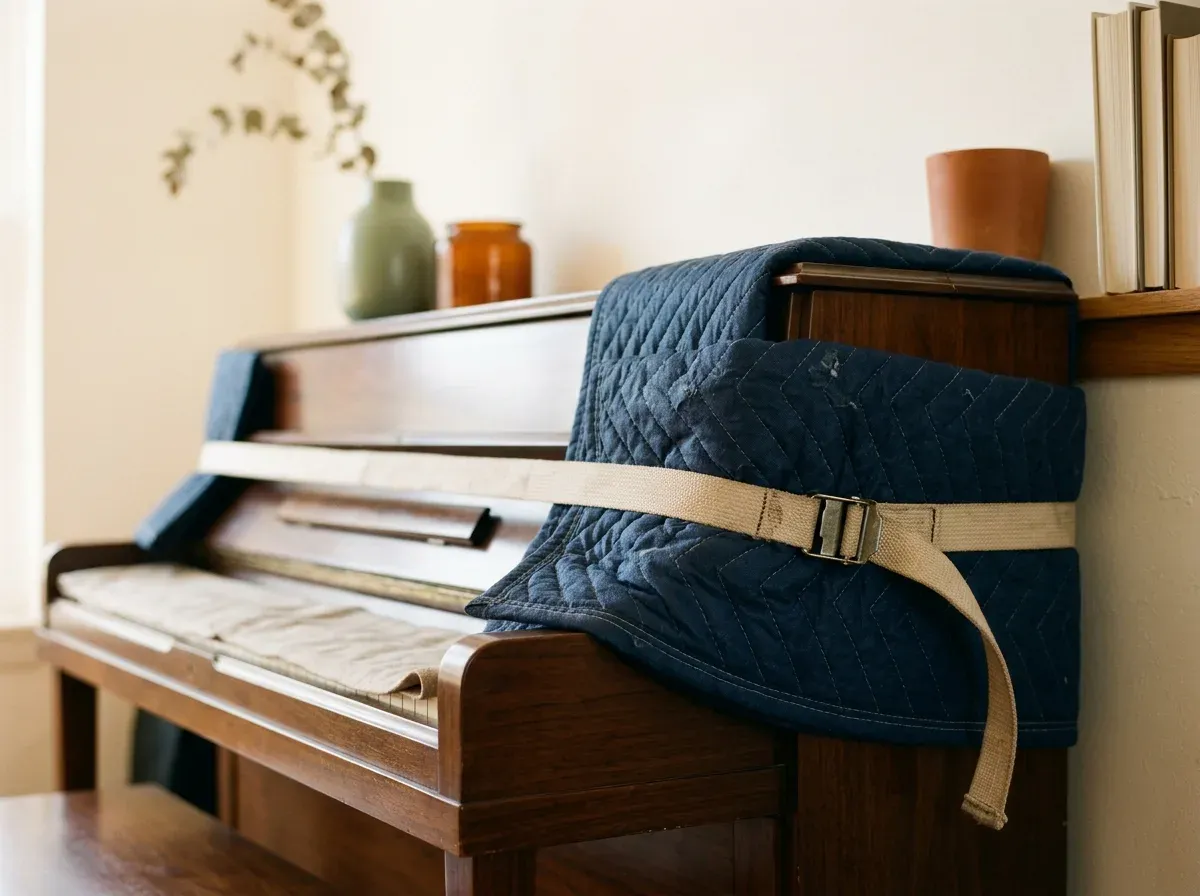
What changes the price
- Stairs. Every flight beyond ground level typically adds a flat per-flight fee — a piano on a third-floor walkup costs meaningfully more than the same piano on a ground floor.
- Doorway and hallway width. Tight turns sometimes require partial disassembly (legs, lid) which adds labor time.
- Upright vs. grand. Grands need to be boarded and often crated for anything beyond a short local move, which is where most of the price gap comes from.
- Standalone vs. bundled. Moving only a piano (no other furniture) usually costs more per job than adding it to an already-scheduled full household move, since the crew and truck are already billed either way.
Stairs drive cost because a crew must tip the piano onto a piano board at each landing, slowing the descent to a crawl and burning labor hours even on a modest staircase. On a spiral staircase the problem worsens, since the tight curve prevents a standard upright move and may force the crew to use rigging straps to lift the instrument instead.
Removing a grand piano's legs is not simply unscrewing hardware; partial disassembly includes the lid and sometimes other components, and the body must be strapped to a padded piano board before transport, which adds measurable billed labor beyond ordinary loading time. If a hallway is both narrow and has a sharp corner, the crew might also need to temporarily remove a door from its hinges or pad the frame, tasks that fall outside a standard moving estimate.
The cost gap between upright and grand moves widens on long-distance shipments because an upright can remain vertical inside the truck, while a grand must stay horizontal on a piano board and often inside a wooden crate to prevent torque on the frame. Crating also means the item takes up more room in the load, which affects how the mover stacks surrounding household goods and can force a rethink of the entire packing plan.
A standalone piano move forces the company to dispatch a crew and a truck for a single item, so the minimum labor charge and fuel surcharge fall entirely on that instrument with no other furniture to absorb the base cost. When the piano rides along with a household shipment, those overhead expenses are already covered by the dining table and sofa, letting the piano appear as a lighter incremental add-on rather than a full job. Bundling also simplifies liability, because one company handles the entire load instead of splitting responsibility between a general mover and a subcontracted piano specialist.
Piano mover or general mover: which do I need?
A standard full-service move can usually fold in an upright piano without a specialist. Grand pianos, spiral staircases, or doorways under about 30 inches are where it's worth specifically asking whether the crew has piano-specific equipment (piano board, piano dolly, rigging straps) — not every general moving crew carries it, and the ones that don't will either subcontract it or ask you to hire a dedicated piano mover separately.
A general moving crew may own appliance dollies and furniture pads, but a piano board is designed specifically to support a grand piano's frame during transport, and standard moving straps may not secure it safely. Without these tools, even experienced furniture movers risk damaging the instrument or the home's trim, which is why reputable companies will admit upfront when they lack the gear rather than improvising on move day.
If a general mover does not handle the piano themselves, they usually have a referral relationship with a dedicated piano mover, though that means coordinating two separate arrival windows and potentially paying a premium for the smaller specialist job. Ask whether the general mover's quote wraps the subcontractor's fee into a single line item or if you will receive two independent bills, because the latter can complicate liability if damage occurs during the handoff between crews.
When a general mover claims they can handle a grand, ask specifically whether they own a piano board and heavy-duty rigging straps, not just whether they have "pads and dollies." The board supports the frame so the body remains stable, and rigging straps loop under the board rather than across the lid; without this setup, a crew may resort to ordinary furniture blankets and rope, which can damage the instrument or let it shift unexpectedly.
Spiral staircases deserve special scrutiny because a piano dolly is useless on a winding tread, so the crew must rely on rigging straps and manual leverage, increasing the risk profile significantly. That elevated risk makes it especially important to confirm insurance details before move day, since the basic released-value coverage most movers include pays only $0.60 per pound and would not cover the replacement cost of a damaged instrument in a staircase incident.
How do I get the piano into my full move estimate?
If you're already comparing full-service moving quotes, flag the piano at the start — it's one of the checkboxes in the calculator above — so every quote you get already accounts for it instead of showing up as a surprise line item after you've booked.
If you wait until after booking to mention the piano, the estimator may not have reserved enough space in the truck, which can force a last-minute upgrade to a larger trailer or a second vehicle on load day. Revealing the instrument during the initial walkthrough or inventory checklist lets the company plan the load order so the piano is among the first items on and last items off, minimizing the time heavy furniture sits on top of or adjacent to it.
A surprise piano announcement can also trigger a revised quote that ignores the competitive pricing you already compared, because the mover knows you are locked in and have fewer options at the last minute. By contrast, when every vendor knows about the piano from the first quote request, you are comparing apples-to-apples totals and can spot which company is burying the piano charge inside a higher hourly rate versus breaking it out as a separate line item.
Even if you are only moving an upright and the company assures you it is routine, confirming the piano in writing before contract protects you from a crew showing up unprepared for the 300–500 lb weight and awkward, shifting distribution that separates an upright from standard furniture. The written estimate forces the dispatcher to assign crew members and equipment specifically for that load rather than treating it as an afterthought that strains an undersized team.
If the piano is a grand, mentioning it early also lets the mover schedule disassembly time into the hourly estimate rather than treating leg removal as an unbilled courtesy that rushes the crew. When the estimate explicitly lists boarding and crating, you have a document to reference if the actual crew arrives without the piano board and attempts to move the instrument on a standard appliance dolly. An estimate that omits these steps often signals that the company is treating the piano as an oversized piece of furniture rather than a specialized load.