
Short answer: a local safe move typically costs $150–$450 depending on weight and access. Folded into a long-distance household shipment, it usually adds a flat $200–$350.
The wide spread between a $150 minimum and a $450 local maximum exists because a safe isn't priced mainly by mileage; it's priced by the total labor minutes and specialized equipment needed to bridge the gap from your hallway to the truck. A ground-floor, garage-to-garage move with a dolly might hit the low end, while a basement vault that must ascend a narrow interior staircase with a turn at the landing consumes an entire morning and pushes toward the upper bound. Long-distance pricing flattens to $200–$350 because the safe is treated as an accessorial item rather than a per-mile shipment, but only if you disclose it before the truck is loaded.
Why does weight class matter so much?
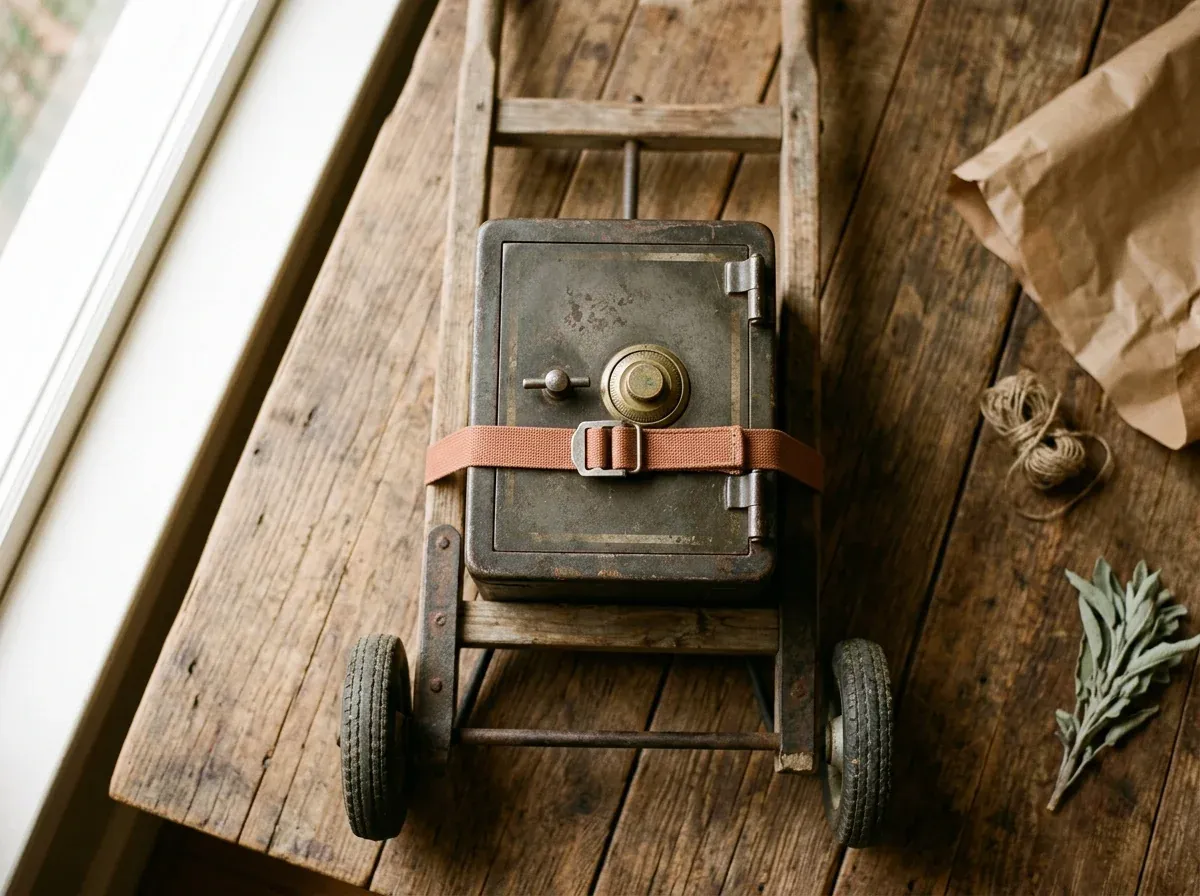
A small fireproof document safe is barely different from moving a heavy piece of furniture. A large gun safe or vault-style safe in the 500–2,000+ lb range is a different job entirely — often requiring a stair-climbing hand truck, additional crew, or a specialized rigging service, especially if it needs to go up or down stairs or through a doorway it barely clears.
A concentrated load in the upper weight ranges creates point stress far beyond what standard furniture dolly wheels were designed for, which is why crews often lay hardboard or plywood pathways across hardwood or tile to prevent cracking, denting, or subfloor compression.
The real difficulty on stairs isn't just the gross weight but the pendulum effect: if the safe shifts even slightly while tilting through a doorway, it can tear off molding, gouge drywall, or punch through a banister before the crew can regain control. That is why vault-style units often require riggers who can float the safe on straps rather than roll it, keeping the mass stable while the feet never touch the treads.
Homeowners routinely underestimate the challenge because the safe has sat motionless for years, quietly distributing its mass across a broad footprint. They forget that the retail delivery crew likely used a power tailgate, a pallet jack, and a larger team of trained workers to install it, resources the homeowner usually does not have access to on move-out day.
The reason a stair-climbing hand truck is non-negotiable for many vault-style units is that rolling a rigid box down stairs creates impact shocks at each tread; the machine's tracked treads or motorized gears convert those drops into a continuous controlled descent, which protects both the staircase and the workers' joints from sudden compression loads.
Weight distribution also explains why two safes with identical external dimensions can behave differently on a dolly; a model with a thick composite fire liner carries far more mass in the same footprint, which changes the floor loading and the number of crew members needed to stop the momentum if it starts to drift on a slope.
Should I empty the safe before moving day?
Beyond the weight savings, most movers' released-value or full-value liability coverage explicitly excludes cash, jewelry, and firearms — meaning if something happens to the contents in transit, you likely have no recourse. Valuables that were in the safe should travel with you directly, not inside the safe on the truck.
Movers' liability tariffs exclude cash, jewelry, and firearms because they cannot verify the contents or value at pickup, which creates a moral hazard: if a moving company accepted open-ended liability for a locked steel box, the claimed loss could potentially exceed the total revenue of the entire job. The exclusion exists in both released-value and full-value policies, so adding extra valuation coverage does not typically restore protection for those specific categories.
Some owners leave firearms inside under the assumption that a locked safe protects them from theft, but the larger risk during transport is violent jostling; a steel box that slides on a truck deck can damage its own interior foam, scratch scoped rifles against the walls, or snap off sight posts even if the lock holds and nothing is stolen.
Interstate shipments add another layer of complication because standard household goods carriers may not be authorized to transport firearms commercially across state lines depending on the route. That regulatory uncertainty is one more reason reputable crews refuse to ship firearms inside a safe, regardless of whether the weapons are loaded or unloaded.
Documents and media inside a safe are also vulnerable to humidity shifts inside a moving truck, especially if the truck is not climate-controlled; removing papers and drives before transport lets you verify that the fire seal has not trapped moisture, which could otherwise warp documents or corrode electronic media during a multi-day long-distance haul.
How do I make sure my safe is included in the full move estimate?
If you're already comparing full-service moving quotes, flag the safe at the start — it's one of the checkboxes in the calculator above — and mention its approximate weight and any stairs involved so quotes reflect the real job rather than a standard furniture estimate.
Online estimators usually default to standard heavy furniture that crews can tilt and walk with straps; a safe does not behave like a refrigerator or dresser because its center of gravity is low and centralized, which means it demands a four-wheel dolly or stair-climbing machine instead of a standard appliance cart, and if the estimator does not know this, dispatch may send a crew with inadequate equipment.
Waiting until loading day to mention the safe is one of the most common mistakes homeowners make, because an unprepared crew may simply refuse to move it, leaving the item behind on closing day. If they do agree to take it, the job becomes a change order priced outside the original quote, which means you lose the benefit of upfront comparison shopping and often pay the highest hourly rate the company charges.
On long-distance shipments, the flat $200–$350 add-on is only available when the safe is declared during the initial survey; if it surfaces later, the driver may lack the proper tie-downs to secure a heavy point load against the sidewalls of a packed trailer, forcing a last-minute equipment swap or a separate pickup that fragments your move schedule.
Providing the manufacturer and model, or at least a photo showing the depth and width, lets the estimator cross-reference the weight rather than relying on your guess, because many owners significantly underestimate the actual mass, and the difference between their guess and reality can determine whether the company sends a standard crew or a specialized rigging team with a stair-climbing dolly.